The “Deep Work” Delusion: Why Working Postgrads Need a New System
The “Deep Work” Delusion: Why Working Postgrads Need a New System
There is a special kind of delusion that accompanies working postgraduates when they try to schedule their research.
It usually strikes around 10:00 PM on a Tuesday. You have just survived an eight-hour corporate workday filled with back-to-back meetings, urgent client emails, and relentless decision fatigue. The house is finally quiet. You sit down at your desk, crack your knuckles, and open your qualitative analysis software. You have scheduled a three-hour block of "deep analytical work."
You stare at the transcript on your screen. You highlight a single sentence and think to yourself: "Is this a groundbreaking phenomenological insight... or is my brain just shutting down?" Spoiler alert: Your brain is shutting down.
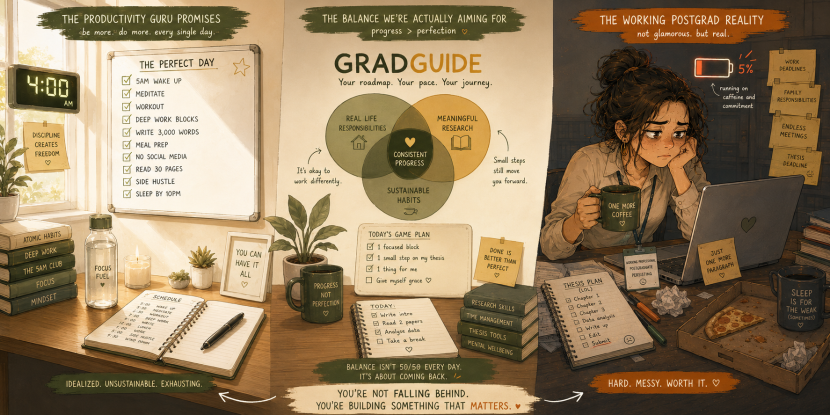
If you have ever found yourself reading the same academic paragraph fourteen times without comprehending a single word, you are not alone. You are experiencing the profound disconnect between modern productivity culture and the reality of being a working scholar. We are constantly told that the secret to finishing a thesis is simply "finding the time." We are told to block our calendars, wake up at 4:00 AM, and hustle harder.
But time does not equal cognitive capacity.
When you are balancing a full-time career with complex academic expectations, you cannot budget your brainpower the same way you budget your calendar blocks. Asking your brain to synthesize theory or thematic coding after a full day of professional problem-solving is like trying to start a car with no battery.
It is time to dismantle the "Deep Work" delusion and build a system that actually understands human exhaustion.
The Myth of Time vs. Cognitive Capacity
The traditional academic model assumes a student whose primary occupation is reading, thinking, and writing. The modern postgraduate reality is entirely different. You are an established professional. You manage teams, navigate corporate hierarchies, handle household realities, and manage real-world crises daily.
Every single one of those tasks drains your cognitive battery.
Productivity gurus love to talk about time management, but they rarely talk about energy management. A calendar block is completely agnostic to your mental state. A digital schedule will happily tell you to write 1,000 words at 8:00 PM, completely ignoring the fact that you just spent the last nine hours resolving a major workplace conflict.
When you sit down to do "deep work" with an empty tank, several things happen:
Analysis Paralysis: You cannot make basic methodological decisions because your executive function is depleted.
Academic Avoidance: You end up color-coding your reference list or reorganizing your folders for two hours just to feel a false sense of momentum.
The Guilt Cycle: You log off having written nothing, and you go to sleep feeling like a failure.
You are not failing because you lack ability, discipline, or dedication. You are failing in that moment because your operating system is fundamentally flawed. You are treating yourself like a machine, when you are actually a human managing a highly complex ecosystem.
Why Productivity Culture Punishes the Working Postgrad
Most productivity frameworks are built on toxic hustle. They rely on rigid lists, aggressive reminders, and streaks. If you miss a deadline, the task turns red. It sits there, glaring at you, a digital monument to your inadequacy.
These tools assume you are a fully optimized machine. They demand that you mold your life to fit the tasks.
For the working postgraduate, this creates an unbearable cognitive load. When you are already stretched to your absolute limits, an overdue notification doesn't motivate you—it triggers a threat response. Your brain, already exhausted, interprets the mounting pressure as a danger to be avoided. This is exactly why students will often avoid opening their thesis document for three weeks after receiving supervisor feedback. The psychological friction is simply too high.
You do not need a system that adds pressure. You do not need a louder alarm clock or a stricter to-do list. You need a system that lowers the friction of starting. You need tools and habits that adapt to your actual capacity, rather than an idealized productivity fantasy.
Diagnosing the Drain: The Hidden Cognitive Load of Research
To fix the system, we first have to understand where the energy is actually going. The working postgraduate carries a hidden cognitive load that traditional students do not.
1. The Context Switch Transitioning from your "corporate identity" to your "academic identity" requires massive mental effort. At work, you might be rewarded for quick, decisive action and bullet-point summaries. In your research, you are required to sit with ambiguity, write with nuance, and build slow, methodical arguments. Forcing your brain to switch gears at the end of the day is exhausting.
2. The Threat of Feedback When you are well-rested, supervisor feedback is data. When you are burnt out, supervisor feedback feels like a personal attack. The emotional labor required to strip the tone from an email that says, "Just a few thoughts on your methodology..." and dig into 40 pages of tracked changes is monumental.
3. The Isolation Factor Research is inherently lonely. When you combine that with the isolation of being the only person in your professional circle pursuing a postgraduate degree, the psychological weight compounds. You are constantly translating your academic struggles for your non-academic peers, which is an energy drain in itself.
The "Capacity Protection" Protocol
If the old way is breaking you, how do you move forward? You stop managing your time, and you start protecting your capacity.
Capacity protection is the radical acceptance that your energy fluctuates, and your research plan must fluctuate with it. It means tracking your state before you track your output.
Imagine starting your evening research session not by looking at your terrifying to-do list, but by doing a realistic "Vibe Check."
Are you alert and ready to synthesize theory? Great, tackle the literature review.
Are you slightly tired but capable of focus? Work on your methodology formatting.
Are you completely fried from a day of corporate firefighting? Acknowledge it immediately.
If the tank is empty, the goal is no longer "deep work." The goal is simply to maintain the habit without burning out. This is where the micro-pivot comes in.
The 15-Minute Micro-Pivot
When your cognitive capacity is low, you must lower the stakes. You cannot force high-level analytical thought, but you can still create momentum. You do this through a 15-minute micro-pivot.
1. The "Terrible Draft" Timer Give yourself permission to be genuinely awful. Set a timer for 15 minutes and write the worst possible version of the paragraph you are stuck on. Do not edit. Do not look up citations. Write it exactly as you would explain it to a friend over a coffee. The goal is to reduce the friction of the blank page. Once the timer goes off, you are allowed to stop. More often than not, simply breaking the seal gets you moving.
2. Low-Cognitive Administrative Wins Keep a running list of thesis tasks that require zero brainpower. When you are exhausted, use your 15 minutes to execute these.
Format your table of contents.
Check your margin sizes.
Ensure your references match your in-text citations.
Rename your chaotic files into a coherent structure.
These tasks have to be done eventually. Doing them when you are exhausted protects your high-energy windows for actual writing and analysis.
3. The Burn Box If you are paralyzed by supervisor feedback, use your 15 minutes purely for emotional processing. Read the feedback, feel the frustration, and manually extract only the technical requirements into a separate, clean document. Close the original email. You have just cleared the emotional noise.
Rest as Resistance
Sometimes, the most academically rigorous thing you can do is close your laptop.
If you are reading this after a brutal day at work, and you are staring down the barrel of a qualitative analysis session, I am giving you permission to step away. Rest is not a reward for finishing your thesis; rest is the prerequisite for having the capacity to finish it.
You are doing something incredibly difficult. You are navigating the complex, messy intersection of a career and advanced academia. You don't need to suffer to earn this degree, and you certainly don't need to force "deep work" on an empty battery.
Protect your capacity, embrace the messy momentum of a 15-minute pivot, and remember that progress is rarely linear. Sometimes, success just looks like letting the plan fall apart for the night so you have the energy to try again tomorrow.
If you are tired of trying to force standard productivity tools to understand your exhaustion, you don't have to manage this alone. We built GradGuide: An intelligent research companion from stuck to submission specifically for the realities of the working postgraduate. Launching for Android and Web on June 5, 2026, it acts as a mentor in your pocket—tracking your capacity through a simple "Vibe Check" and automatically pivoting your schedule to 15-minute micro-tasks when your battery is low. It is designed to lower your cognitive load and help you find that messy momentum, one sustainable step at a time.

Article by Research4you
Published 27 May 2026